The Outlaw brand archetype: meaning, examples and names
The Outlaw is the rebellious brand that breaks the rules worth breaking. What its customers need, brands that play it, how it sounds and what it does to a name.
The deepmarks team · · 4 min read
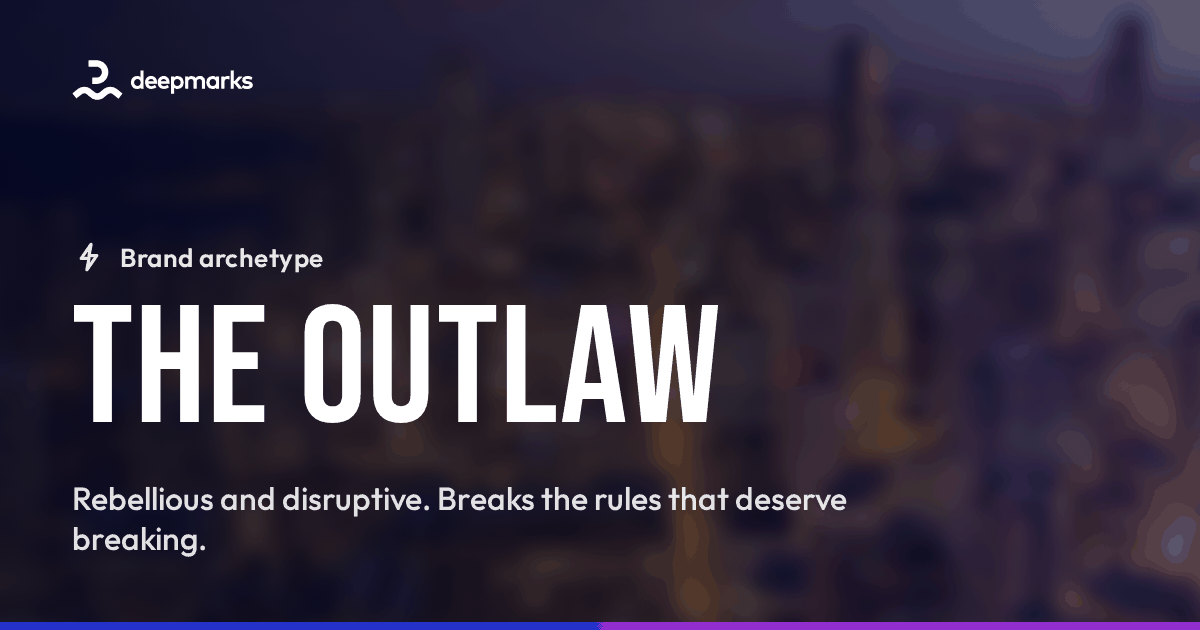
The Outlaw is the brand that breaks the rules that deserve breaking. It is rebellious and disruptive, and it earns trust by standing apart from how things are usually done. Harley-Davidson, Diesel and Virgin all play it.
It is one of the 12 brand archetypes, the personalities a brand can have if it were a person.
What Outlaw customers need
To break free from how things are done and feel different. An Outlaw customer feels boxed in, by a dull industry, a big incumbent or a life that runs on someone else’s rules, and wants a brand that is on their side.
What they fear is being ordinary, managed or told what to do. So an Outlaw brand picks something to stand against, the old way or the big player, and makes its customers part of the crowd that stands with it.
Brands that play the Outlaw
- Harley-Davidson has made motorcycles since 1903, and sells the open road as much as the machine.
- Diesel has advertised under the line “For Successful Living” since 1991. Its 2010 campaign, “Be Stupid”, ran posters that the UK’s advertising regulator ruled against.
- Virgin took on British Airways in 1984, when Virgin Atlantic’s first flight left Gatwick for Newark under Richard Branson, then best known for Virgin Records.
None of them is the Outlaw because of what they sell. Motorcycles, clothes and an airline are very different businesses. They share a promise: you don’t have to do it their way.
Watch the Outlaw in action
Harley-Davidson released this film in April 2026 to launch its new brand platform, RIDE, along with the return of its classic bar and shield logo. It shows riders of all kinds in cities and on open roads. Notice the grown-up Outlaw here. There is no fight with anyone, only the freedom of leaving the ordinary day behind, and the company of people who chose the same.
When the Outlaw fits, and when it doesn’t
When it fits: your brand breaks the rules of its industry and speaks to people who feel like outsiders: a challenger to big incumbents, a product for a subculture, anything people choose to say “not like them”. If your customers ask “why does it have to be this way?”, the Outlaw is a natural fit.
When it fights the customer: a product people buy for safety, trust or care. An Outlaw bank makes people worry about their money. An Outlaw baby brand frightens the parents. And rebellion ages fast: when the challenger wins and becomes the big player, the Outlaw voice can start to sound like a costume.
How the Outlaw sounds
Blunt, confident and a little rough. The Outlaw doesn’t ask permission or explain itself at length. It says what it’s against, then what it’s for.
The words it reaches for come from the world after dark and off the main road, not from your category: asphalt, smoke, rust, neon, chrome, leather, static, alley, ash, gravel, midnight. Its images are the highway at night, the garage, the back room, the city after closing time.
For its names, try a blunt sound: one syllable with a hard stop, or a real word used against its usual meaning. A name that sounds slightly wrong the first time often fits the Outlaw better than one that sounds right.
What the Outlaw does to a name
An Outlaw name sounds like it doesn’t care whether you approve.
- Kinds that suit it: short real words with grit, everyday words turned against their usual meaning, and founder names with a story behind them. See the six kinds of startup names for each kind’s traps.
- The trap: the archetype’s own clichés. Rebel, Rogue, Renegade, Maverick, Disrupt and Anarchy are on thousands of companies, and they announce rebellion instead of showing it. Skulls and flames, too.
- A test: who is this name against? If it could sit on any company’s door and offend nobody, it isn’t the Outlaw. If it offends your own customers, it isn’t either.
Good partners for the Outlaw
Most brands play one personality strongly and borrow from one or two others. The Outlaw pairs well with:
- The Explorer, for freedom and the open road: a life off the usual map.
- The Jester, for irreverent brands that mock the old way of doing things.
- The Hero, for challengers that take on a giant on their customers’ behalf.
An Outlaw with a Lover can work (fashion or drinks with an edge), but it needs care: provocation that only wants attention gets old fast.
The Outlaw in deepmarks
In the deepmarks brief, two answers point to the Outlaw:
- “If your brand were a person, what would they be like?” Rebellious
- “What should your customers feel when they use your brand?” Rebellious
deepmarks reads the rest of your brief too, then suggests three personalities, in order, and says why in your own words. If the Outlaw isn’t among them and you want it, click Change next to the personality on your names, then Read & watch on The Outlaw, and Use as Primary. The first personality colours most names; the second and third add range.
The names written as an Outlaw are shown in Bebas Neue, tall, condensed capitals, over a picture of Chicago’s city lights at night.
The Outlaw in short
- Promise: you don’t have to do it their way.
- Customers need: to break free from how things are done and feel different.
- Sounds: blunt, confident, a little rough.
- Avoid: Rebel, Rogue, Renegade, Maverick, and skulls.
- Pairs with: the Explorer, the Jester, the Hero.