Brand archetypes: the 12 brand personalities, and how to choose yours
The 12 brand archetypes explained, with examples, a 10-minute exercise to find yours, how to blend two or three, and what the choice does to a name.
The deepmarks team · · 12 min read
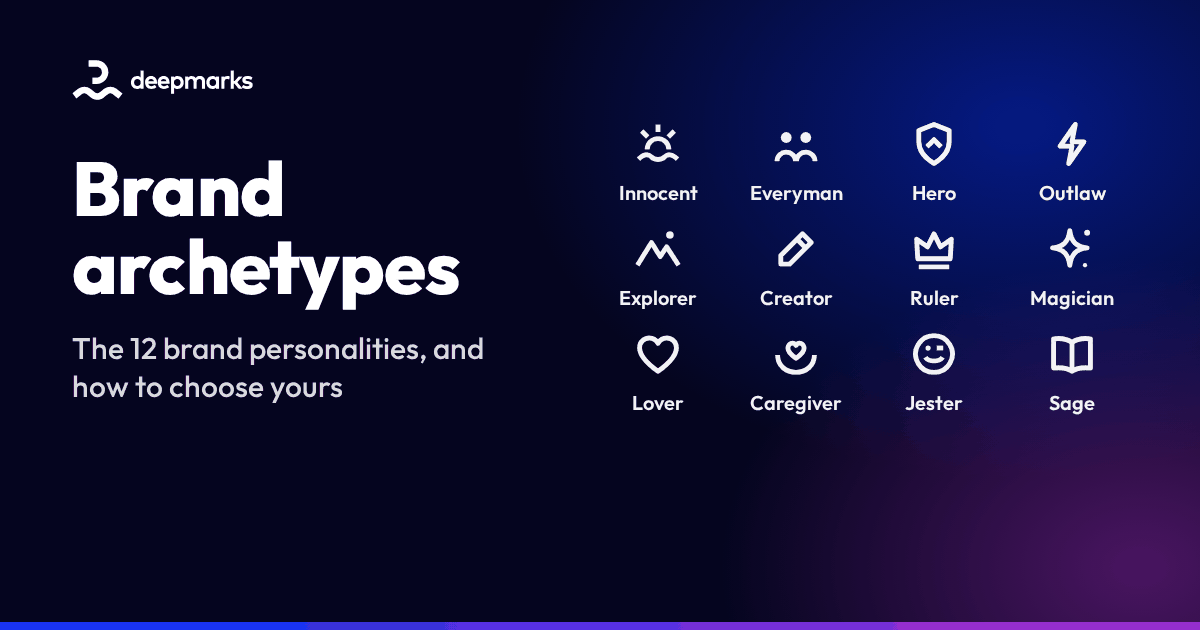
A brand personality is the character your brand would be if it were a person: wise or funny, caring or rebellious, calm or bold. The 12 brand archetypes are a shared vocabulary for that character. Most strong brands play one archetype clearly and borrow a little from one or two others.
This guide explains the 12, gives a short exercise to find yours, shows how to blend them, and what the choice changes, starting with your name.
Where the 12 archetypes come from
The idea starts with the psychologist Carl Jung, who described archetypes as characters every culture recognises: the hero, the wise old man, the trickster, the mother. In 2001, Margaret Mark and Carol S. Pearson brought them to marketing in their book The Hero and the Outlaw, which set out the 12 that brands use today.
The framework is a tool, not a science. Nobody can measure that a brand “is” a Sage. What it gives you is a shared language: a founder, a designer and a copywriter can say “we’re a Caregiver with a touch of the Sage” and mean the same thing. That makes hundreds of small decisions consistent, from the name to the colour of a button.
The 12 brand archetypes at a glance
| Archetype | In one line | What its customers need | Brands that play it |
|---|---|---|---|
| The Innocent | Optimistic, honest and simple | Simplicity, safety and a sense that things will be fine | Dove, Innocent Drinks, Coca-Cola |
| The Everyman | Friendly, down-to-earth, for everyone | To belong, and to get something good without pretence | IKEA, Target, Levi’s |
| The Hero | Brave and determined | To prove themselves, win and become stronger | Nike, FedEx, Duracell |
| The Outlaw | Rebellious and disruptive | To break free from how things are done | Harley-Davidson, Diesel, Virgin |
| The Explorer | Adventurous and independent | Freedom, discovery and a life that isn’t boring | Patagonia, Jeep, The North Face |
| The Creator | Imaginative and expressive | To express themselves and build something original | LEGO, Adobe, Canva |
| The Ruler | Confident and in control | Control, stability and the reassurance of the best | Mercedes-Benz, Rolex, Microsoft |
| The Magician | Visionary and transformative | To see their situation change as if by magic | Disney, Apple, Tesla |
| The Lover | Passionate and sensual | To feel desired, special and close to others | Chanel, Godiva |
| The Caregiver | Caring and dependable | To feel protected, supported and looked after | Johnson & Johnson, Volvo, UNICEF |
| The Jester | Funny and playful | To enjoy the moment and not take life too seriously | M&M’s, Old Spice, Duolingo |
| The Sage | Wise and thoughtful | Truth, knowledge and good decisions | Google, BBC, Harvard |
Mark and Pearson group the 12 by the basic need each one answers. It’s a useful first cut when you’re unsure where to start:
- Stability and control: the Caregiver, the Creator, the Ruler.
- Belonging and enjoyment: the Everyman, the Jester, the Lover.
- Risk and mastery: the Hero, the Magician, the Outlaw.
- Independence and fulfilment: the Innocent, the Explorer, the Sage.
The 12, one by one
Each archetype has its own post with its ad, its voice, its word bank and what it does to a name. In short:
The Innocent
The Innocent promises that life can be simple and good. It speaks plainly, smiles easily and never frightens anyone. It fits natural products, family brands and feel-good everyday things. Its trap is sounding naive or sugary. Read about the Innocent.
The Everyman
The Everyman is one of us: friendly, practical, no airs. It wins with good value and a sense of belonging, not with status. It fits brands for everyone, at a fair price. Its trap is being so ordinary that nobody remembers it. Read about the Everyman.
The Hero
The Hero helps people rise to a challenge and win. Its voice is direct and energetic, its names short and hard. It fits sport, performance and getting tough jobs done. Its trap is arrogance, or a fight the customer never asked for. Read about the Hero.
The Outlaw
The Outlaw breaks the rules that deserve breaking. It speaks to people who feel like outsiders and dares them to do things differently. It fits challengers to a sleepy or unfair industry. Its trap is rebellion as a costume, with nothing behind it. Read about the Outlaw.
The Explorer
The Explorer is about freedom and discovery: new places, new ideas, your own way. Its voice is bright and quick, its images are roads and horizons. It fits travel, the outdoors and anything that widens a life. Its trap is restlessness that never commits. Read about the Explorer.
The Creator
The Creator helps people make things and express themselves. It values craft, originality and the joy of building. It fits tools, design and anything people use to make something of their own. Its trap is perfectionism that talks about itself instead of the customer’s work. Read about the Creator.
The Ruler
The Ruler stands for the best, and for being in control. It is polished, confident and calm. It fits premium products, leadership and anything that promises order. Its trap is coldness: authority without warmth. Read about the Ruler.
The Magician
The Magician turns something hard into something effortless, as if by magic. It promises transformation. It fits technology and experiences that change how something feels. Its trap is promising magic and delivering an ordinary product. Read about the Magician.
The Lover
The Lover is about beauty, pleasure and feeling special. Its voice is warm, sensual and close. It fits fashion, fine food, fragrance and indulgence. Its trap is excess: the promise becomes a cliché. Read about the Lover.
The Caregiver
The Caregiver looks after people. It is warm, patient and dependable, and it puts the customer’s safety first. It fits health, safety, support and service. Its trap is sounding anxious or preachy. Read about the Caregiver.
The Jester
The Jester makes things fun and doesn’t take itself too seriously. Its names are bright and quick, its tone is a wink. It fits a dull category that deserves a laugh. Its trap is a joke that wears out, or one at the customer’s expense. Read about the Jester.
The Sage
The Sage helps people understand and decide well. It is calm, precise and earns trust by being right. It fits knowledge, research, data and expert advice. Its trap is lecturing. Read about the Sage.
How to choose your brand archetype: a 10-minute exercise
You don’t need a workshop. Answer two questions honestly, count, then check.
Step 1: describe your brand as a person
If your brand were a person, what would they be like? Pick up to three words from this list, the three that fit best, not the three you admire most:
Friendly, Caring, Wise, Brave, Rebellious, Adventurous, Creative, Confident, Magical, Passionate, Funny, Honest.
Step 2: describe what your customers should feel
What should your customers feel when they use your brand? Pick up to three:
Safe, Enlightened, Free, Rebellious, Transformed, Empowered, Adored, Delighted, Belonging, Cared for, In control, Inspired, Understood, Prestigious, Reassured.
Step 3: count the votes
Each answer points to an archetype. Give one point for each, and half a point to each side of the two shared answers:
| Archetype | Brand as a person | What customers feel |
|---|---|---|
| The Innocent | Honest | Safe, Reassured (½) |
| The Everyman | Friendly | Belonging |
| The Hero | Brave | Empowered |
| The Outlaw | Rebellious | Rebellious |
| The Explorer | Adventurous | Free |
| The Creator | Creative | Inspired |
| The Ruler | Confident | In control, Prestigious |
| The Magician | Magical | Transformed |
| The Lover | Passionate | Adored, Understood (½) |
| The Caregiver | Caring | Cared for, Reassured (½) |
| The Jester | Funny | Delighted |
| The Sage | Wise | Enlightened, Understood (½) |
The archetype with the most points is your likely primary. The next one or two are your secondary and third. These are the same answers deepmarks asks for in its brief, and the same table it starts from.
Step 4: check it three ways
- Against your customers. Read what that archetype’s customers need (the table above). Is that what yours need? A founder may feel like a Rebel while the customers want a Caregiver.
- Against your competitors. If every brand in your category already plays the Sage, a Sage of your own will blend in. A different primary, or a strong secondary, can set you apart.
- Against your category. Some pairings are hard. A bank can be a Jester, but it has to earn trust first. A children’s brand can be a Ruler, but it will feel strict. Hard isn’t impossible; it means you’ll have to work for it.
If the result surprises you, read the two candidates’ posts side by side. The one that sounds like how you’d talk to a customer on a good day is usually the right one.
Primary, secondary, third: blending archetypes
One archetype leads. It sets the voice, the promise and most of the decisions. The second and third add range: a softer side, a sharper edge, a second register for different moments.
Some blends work naturally because the archetypes want similar things:
- The Sage with the Caregiver: explains in order to protect. Health information, financial guidance.
- The Explorer with the Hero: discovery that demands effort. Outdoor gear, expeditions.
- The Creator with the Magician: tools that make making feel effortless.
- The Everyman with the Jester: friendly and funny, for everyday products that don’t take themselves seriously.
- The Ruler with the Lover: luxury that is both commanding and sensual.
Others pull against each other and need care:
- The Ruler with the Jester: authority and mockery. It can work if the joke never touches the promise.
- The Innocent with the Outlaw: purity and rule-breaking. Usually one of them wins and the other feels false.
- The Sage with the Lover: reason and desire. It works when the knowledge serves the pleasure, as in fine wine or perfume.
A rule of thumb: the primary should be obvious within a few seconds of meeting the brand. If people can’t tell which archetype leads, the blend is too even. A real test of the same three archetypes in two orders: how to blend brand archetypes.
What your archetype changes
The archetype isn’t decoration. It decides many things that look unrelated:
- Your name. A Hero’s name tends to be short and hard; a Caregiver’s soft and round; a Jester’s bright and quick. The words come from the character’s world, not your category’s: a Sage reaches for light, lens and source, an Explorer for road, ridge and horizon. The six kinds of startup names suit archetypes differently, too. One brief named as a Ruler and as a Jester: how your brand’s personality shapes its name.
- Your voice. How long your sentences are, whether you joke, how you say no, how you apologise.
- Your look. Type, colour and pictures. A Ruler’s serif and a Jester’s rounded letters say different things before anyone reads a word.
- Your story. What your brand’s story is about: a quest, a rescue, a discovery, a homecoming.
Common mistakes
- Choosing the archetype you admire, not the one your customers need. Many founders want to be the Hero or the Outlaw. Their customers may need a Caregiver.
- No primary. Three equal archetypes read as no personality at all.
- Naming the brand after the archetype. Names like Hero, Sage, Quest, Magic or Rebel are on thousands of companies. They tell people what you’d like to be rather than show it.
- Changing it every quarter. A personality is built by repetition. Change the campaign, not the character.
- Treating it as a label. Writing “we are a Sage” in a brand book changes nothing. The archetype has to show in the name, the words and the design.
What deepmarks does with your brand’s personality
deepmarks is a naming agent for startups, and the personality is part of every round:
- It suggests three. From your brief and the answers above, deepmarks suggests a primary, a secondary and a third, and says why, in your own words when it can.
- You can change them. On your names, click Change next to the personality to see all 12, read about each one, watch its ad, and set the order yourself. The first colours most names; the others add range.
- The names are written in that voice. One of the six writers works only from the personality: what the character would say about your business, in its own words. Every name is tagged with the archetypes it fits.
- The ranking weighs the fit. A critic reads the round and scores each name on how well it fits your business, your audience and your personality, with the primary counting most.
- Each name is shown in character. A name’s card sets it in its personality’s typeface over a picture of its mood, so you can see how it would feel as a brand.
Questions people ask
Can a brand have more than one archetype?
Yes, and most do. One leads and one or two support it. What doesn’t work is several archetypes with equal weight: the brand ends up with no clear character.
Can a brand change its archetype?
It can, slowly and on purpose, usually when the business itself changes. A sudden change confuses the people who already know you. A rename is often the moment to do it, because everything is being decided again anyway.
Is a brand archetype the same as a tone of voice?
No. The archetype is the character; the tone of voice is how that character writes. A Sage’s tone of voice might be calm, precise and plain. The archetype comes first and the tone follows from it.
Which archetype is best for a tech startup?
There isn’t one. Many tech brands lean on the Magician (it just works) or the Sage (it helps you understand), which is exactly why another choice can stand out. Start from what your customers need, not from what tech brands usually do.
Is the framework scientific?
No. It is a tool for thinking and deciding together, built on stories people across cultures recognise. Use it to make consistent choices, not as a test with one right answer.
Find names in your brand’s personality
Try the exercise above, then give deepmarks one sentence about what you’re building. It will suggest your three archetypes, let you change them, and write a round of names in that voice, each with its reason and a domain check.